
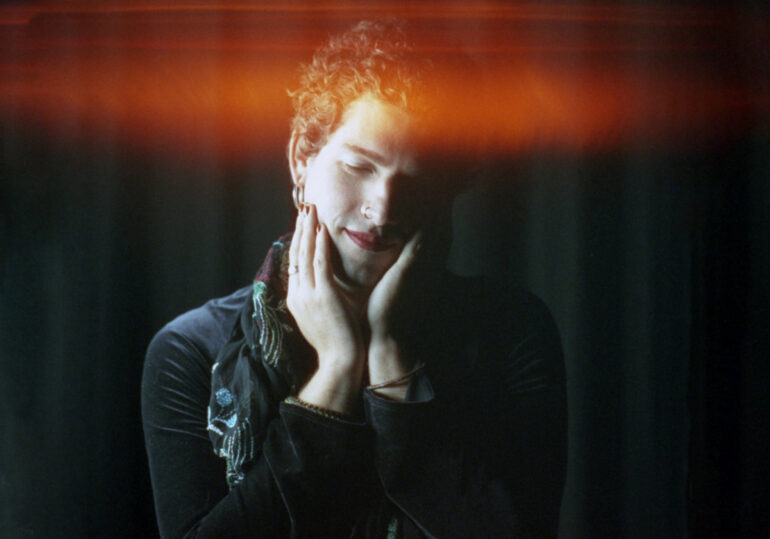
Lau Ro
Booking Agent : Luca Ciscognetti, Marco Portello & Ricky Biondetti
São Paulo-born, Brighton-based artist Lau Ro presents their second album Lau, and first for Mexican Summer, a tender, deeply introspective collection of orchestral psych-pop songs borne from discomfort and disorientation. Recorded and collaged together in spurts of energy, Lau is naturally cerebral, yet the challenging period yielded music that’s unexpectedly radiant, compassionate, and, above all, honest, spiritually aligned with the resolve of the natural world.
Shortly after the release of Cabana (Far Out Recordings, 2024), the non-binary singer and composer’s first solo effort outside of the band Wax Machine, their chronic bouts with Sciatica developed into a debilitating form of Flat Back Syndrome, leaving them unable to stand or sleep, in a haze of opioids, among other medications, for over a year. “Pain comes for everyone in some way or another, but you choose whether to let it harden you or allow it to soften you,” says Ro, who triumphantly chose the latter, suffusing that softness with an enduring love for bossa nova, tropicalia, and Música popular brasileira.
On Lau, Ro resumes a sonic exploration that began on Cabana, tapping into their Brazilian roots and the culture’s rich history of folk, rock, and jazz with a distinctly modern, homespun savviness. An ability to run various legacies through a prism all their own, singing in both English and Portuguese. Ro also drew from their experience playing percussion on Jessica Pratt’s European tour for Here in the Pitch. “It was so refreshing to witness firsthand how large groups of people can sit quietly in a space and share the experience of delving into such introspective and sensitive energy.”
While Cabana reached for an imagined utopia, Lau pushes both outward and inward, housing surrealist visions, self-confrontations, and therapeutic excavations of the soul. When discussing the intention of their practice, Ro cites albums with “the willingness to unmask,” such as Clube da Esquina by Milton Nascimento and Lô Borges, and the holistic approach nature takes in creating biodiverse ecosystems, such as the Mata Atlântica, the tropical rainforest that extends along Brazil’s Atlantic coast. “There is space for all its manifestations to fulfill their role, and the result is astonishing beauty.”
Despite constant agony, sedation, and seclusion, Ro saw their only way out was through: locating and holding that beauty. Their physical limitations became fixed parameters for recording, first in their mother’s garage and later at a rented flat in Brighton. Rather than full takes, Ro captured improvised layers on a 4-track cassette recorder and later built out the tracks in a DAW, giving the work a highly textural, three-dimensional feel. “I felt drawn to this approach as it allowed me to plant the seeds of each piece quite intuitively, away from screens and grids. I was making the conscious decision to embrace imperfection.”
The windswept songs brim with detail, threading string arrangements from Finn Rees (added at Baltic Studio, London) around Ro’s myriad layers (vocals, guitar, bass, drums, percussion, keyboard, and more). The album’s muted blue cyanotype-derived artwork mirrors the sound as well as Ro’s bouts with dysphoria, deepened as a result of spinal changes from sustained contractions. “Making an album for me seems to always come with an entire deconstruction of my identity…the work pushes me to look at myself to such a degree that I no longer recognise who I’m looking at. I commit to embracing whatever comes out of that undifferentiated state.”
The music speaks to multiplicity: how our bodies contain countless cells and systems that contribute not just to our living being but to the planet and the universe. “Each track is a vehicle for different parts of my psyche, some of which can and often do contradict each other,” they explain. “It’s a bit of a meditation on the idea that my body and mind are not private property owned by a big boss that lives in my head. They naturally belong collectively to all living aspects of my being, which extend far beyond this individual body.”
Between pleasant and poignant instrumental passages (“Tecelagem,” “Mito do Fim 2,”“Corn Moon”), lyrics revolve around the subconscious and self-acceptance. Over the light piano phrasings and percussion of “Mito do Fim” (translation: “Myth of the End”), Ro asks, “Como é que deixa de sonhar? Or “How do you stop dreaming? On “O Nó”, they liken the past to a knot buried deep in their body, lifted by flourishes of violin and cello, as Ro’s hopeful words, strums, and keys land slowly in the foreground with a touch of melancholic whimsy.
Lau is the sound of a young artist finding tranquility during an existential test; they call it “a personal diary of someone who feels like a stranger in this world.” On the clear-eyed “Um A Mais”, they sing “Já fiz as pazes / Com o ser / E não ser mais” (“I’ve already made peace / With being / And not being anymore”), leaving the listener with the sense that earthly, body-bound concerns are but a fleeting moment in a greater framework.
Official // Instagram // Bandcamp
No shows booked at the moment.
Facebook | imprint | privacy policy
© 2026 Swamp Booking